
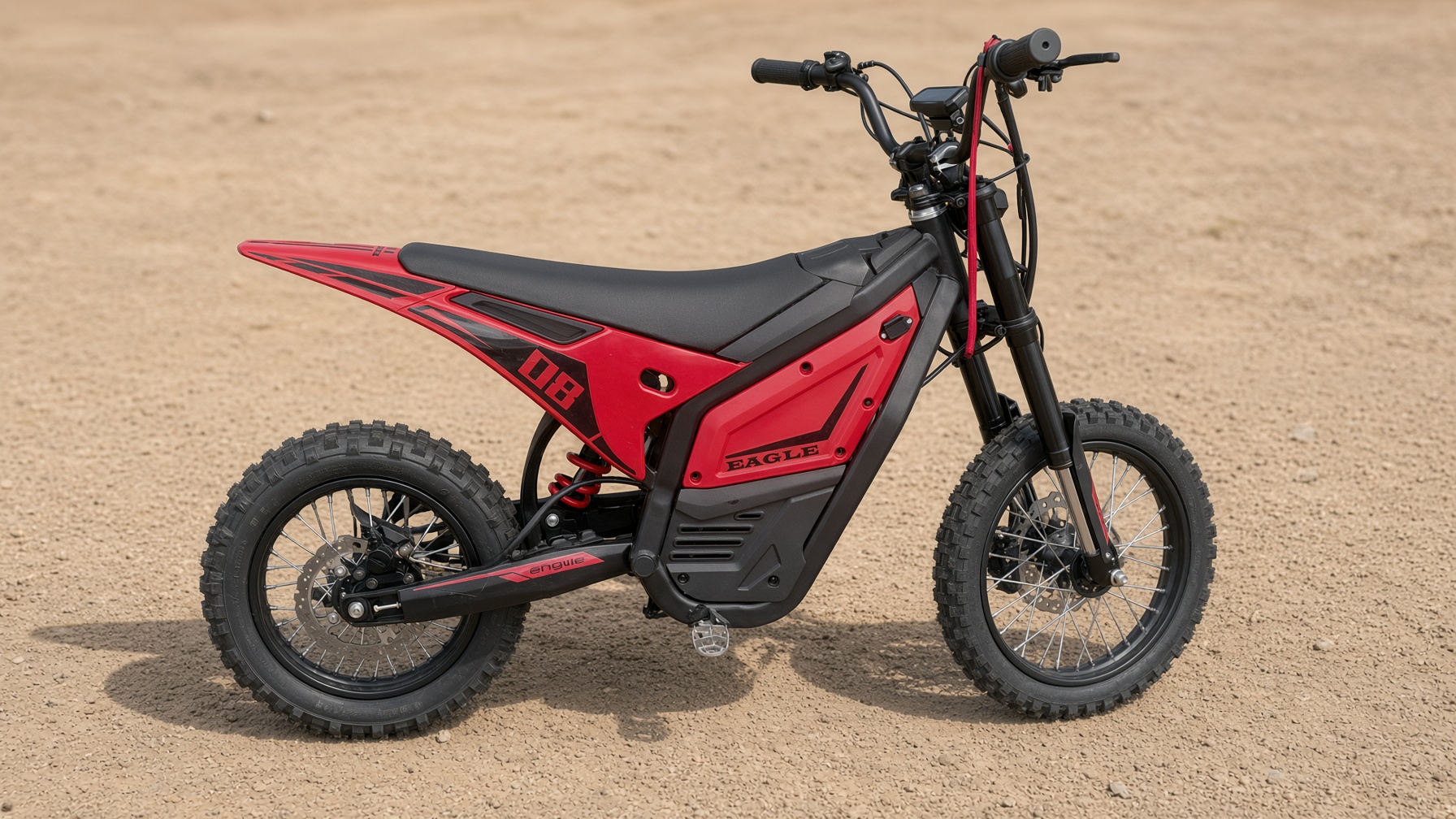
ENGWE Eagle: 45 mph on the Page, About 27 in One Heavy Test
The US page lists the Eagle at $899, from $1,199. Peak is 3,200 watts. The pack is 52 volts and 27 amp-hours, which is 1,404 watt-hours. Claimed speed is 45 mph. A 260-pound ride reported about 27. It is not a Class 1, 2, or 3 bicycle.
By SickEBike desk
The short answer
The ENGWE Eagle is a 14/12 mini e-moto, not a Class 1, 2, or 3 bicycle. The US page lists $899, down from $1,199, a 3,200-watt peak mid-drive, 220 newton-meters, and a 45 mph claim. The pack is 52 volts and 27 amp-hours. Fifty-two times 27 is 1,404 watt-hours. A MAXAPACITY ride at 260 pounds saw about 27 mph, not 45.
The ENGWE Eagle is a 14-inch-front, 12-inch-rear mini e-moto, not a Class 1, 2, or 3 e-bike, and not the E26 3.0. The US product page this desk opened lists it in stock at $899, down from $1,199, in black and red. One thousand one hundred ninety-nine minus 899 is 300. The chips are a 3,200-watt peak mid-drive, 220 newton-meters, 45 mph, a 52-volt 27 amp-hour pack, 55 miles, and a 30-degree climb. Fifty-two times 27 is 1,404 watt-hours. The page does not print that product. A MAXAPACITY description does. Electrek’s 7 September 2026 review prints the same motor, the same pack, IPX4, 200 mm hydraulic discs, a 3-amp charger, high-carbon steel, 48 kg, and a 120 kg load. This desk did not ride it.
What the US page prints, and what Electrek added
US page, this crawl. Electrek, 7 September 2026, where the page is silent. MAXAPACITY’s 6 September 2026 description is the only measured speed on this page.
| What is printed | |
|---|---|
| Price | US page: $899 from $1,199, in stock. Electrek: $899 after the code ELECTREKCO. MAXAPACITY’s description: a $999 September promo, and $899.10 with a code. Do not average the carts. |
| Motor | 3,200W peak mid-drive. 220 Nm. No nominal watt on the page this desk opened. |
| Pack | 52V 27Ah. The page does not print watt-hours. Fifty-two times 27 is 1,404. MAXAPACITY prints 1,404Wh. |
| Speed | Page and Electrek: 45 mph. The comparison block also prints 72 km/h next to 45 mph. MAXAPACITY, rider 260 lb: about 27 mph. A 70-amp controller tune gained only a few more. |
| Range | 55 miles, throttle, ideal conditions, and a 5-to-6-hour riding duration in the same footnote. No rider weight on that note. No tested loop on this desk. |
| Chassis | Page: 105.8 lb, load 264.5 lb, height 4.2 ft to 5.9 ft, Junkai 14/12 tires, hydraulic brakes, LCD, two shocks. Electrek: 48 kg, 120 kg, IPX4, 200 mm rotors, high-carbon steel, full suspension, 3A charger, 5–6 hour charge. |
| Climb | US page: 30 degrees. Electrek’s table: 30 percent. Those words are not the same grade. |
One thousand four hundred four watt-hours, and a charge line that may be a ride line
Fifty-two times 27 is 1,404 with nothing left over. If the 55-mile throttle claim happens, 1,404 divided by 55 is about 25.5 watt-hours a mile. That is a brochure rate. It is not a loop. The page’s footnote ties 55 miles and a 5-to-6-hour riding duration to ideal conditions. Electrek’s spec table calls 5 to 6 hours a charge, on a 3-amp charger. A riding duration and a charge time can both be five hours and still be different jobs. This crawl cannot see which sentence Electrek copied. Do not plan the day on either one until the sheet you paid for says charge, not ride. The watt-hour page is the multiplication. The matched 3-amp brick, if that is the one in the box, is the charger. A random 52-volt brick is not.
Forty-eight kilograms is the Electrek weight. Forty-eight times 2.2 is 105.6, and the more precise pound is 105.8, which is the number the US page prints. The two weights are one claim, not a second scale. One hundred twenty kilograms is Electrek’s load. That is 264.5 pounds at the same conversion the page uses. A 260-pound rider is four and a half pounds under that ceiling. The speed test below is a rider at the top of the load, not a 140-pound teen.
Forty-five is the claim. About twenty-seven is one heavy rider.
MAXAPACITY published a review on 6 September 2026. The description says the rider weighs 260 pounds, the bike would not hit 45 mph, and the measured top was about 27. They then set a FarDriver controller to 70 line amps. Seventy times 52 is 3,640 watts, which is 440 watts over the 3,200-watt peak ENGWE prints, and the description says that tune added only a few miles an hour. This desk did not see the GPS file. “About 27” is their sentence, not a tenth. A lighter rider may see more. A page that prints 45 without a rider weight has not answered that. Do not average 27 and 45 into 36. Seventy-two kilometers an hour is the metric line next to 45 mph on ENGWE’s own comparison block. Forty-five miles an hour is about 72.4 kilometers an hour. They rounded. It is still a claim.
A 3,200-watt peak and a 45 mph claim fail the bicycle test before the controller is opened. Under 750 watts, working pedals, and motor-only under 20 mph is the federal line. This machine has pegs.
Thirty degrees is not thirty percent
The US page says 30 degrees of climb. Electrek’s table says 30 percent. A 30 percent grade is a rise of 30 feet in 100 of horizontal. A 30-degree slope is much steeper: the rise is about 58 percent of the run. Someone used the wrong word. This desk will not pick a winner without a hill and a gauge. The motor page is why 220 newton-meters at a mid-drive is not the same sentence as 220 at a hub. There is no hub on this sheet.
The height band starts at four point two feet
The product title says kids and teens. The headline says teens and adults. The height line is 4.2 ft to 5.9 ft. MAXAPACITY’s description says the bike is for riders 5 ft 9 in and under. Five feet nine inches is 5.75 ft, not 5.9. That is a different ceiling, about two inches. Electrek’s 7 September review says these bikes are off-road and are not legal on the road in almost any jurisdiction, and that children will ride them on streets anyway. A 45 mph throttle machine with a height band that starts at 4.2 ft is not a sidewalk bike and not a first bicycle. This desk is not going to write a setup guide for a child. Private land, a helmet that matches an off-road motorcycle rather than a commute, and an adult who has read the speed claim against the heavy-rider test. The manufacturer’s marketing is not a state statute.
The other 14/12 bikes already on this desk
The Heybike Villain is the other 45 mph claim, with a GPS test: RiderGuide recorded 44.3 mph. Its peak on the sports page is 4,160 watts. Four thousand one hundred sixty minus 3,200 is 960. Its pack is 52 volts and 26 amp-hours, which is 1,352 watt-hours, 52 fewer than 1,404. The US sale this desk filed is $1,299, which is $400 over the Eagle’s $899. The Tuttio Soleil01 US page prints 3,000 watts peak, 200 newton-meters, modes up to 40 mph, and $998.99, on a 48-volt 21 amp-hour pack. Forty-eight times 21 is 1,008. A UK page for that name prints 2,000 watts and 37 mph. The Eagle’s comparison block puts the Tuttio at 37 mph and 200 newton-meters and the Yozma IN 10 at 40 mph and 146 newton-meters. Those are ENGWE’s cells, not those brands’ carts. The Villain versus Tuttio page is the GPS the Eagle still does not have.
Who it is for
Buy it if you wanted a short-rider pit bike near $899, you have somewhere off public roads to use a 45 mph claim, and you have already cut that claim down for a heavy rider. Skip it if you needed a Class 2 commute, a folding bike, or the E26. Skip it if 5.9 ft is your height and you have not sat on it: the other review’s ceiling is 5 ft 9 in. The warranty crawl found an $89 one-year extension and did not find the base term. Read that before you pay. A two-bike combo page listed $1,748 from $2,398. Two times 1,199 is 2,398. Two times 899 is 1,798. The combo is $50 under two sale prices, on the day both carts say that. Confirm the button.
Questions people ask
Is the ENGWE Eagle a Class 3 e-bike?+
No. The page claims 45 mph and a 3,200-watt peak mid-drive, with foot pegs rather than bicycle pedals. Class 3 stops at 28 mph of pedal assist, and the federal motor line is under 750 watts. Electrek says it is not legal on the road in almost any jurisdiction.
How fast is the ENGWE Eagle?+
The US page and Electrek print 45 mph. MAXAPACITY’s 6 September 2026 description says about 27 mph at 260 pounds, and that a 70-amp tune added only a few miles an hour. Seventy times 52 is 3,640 watts. Do not average 27 and 45.
What battery is in the ENGWE Eagle?+
52 volts and 27 amp-hours. The product page does not print watt-hours. Fifty-two times 27 is 1,404. The range line is 55 miles in throttle mode under ideal conditions, with no rider weight. 1,404 divided by 55 is about 25.5 watt-hours a mile, if that claim happens.
How much does the ENGWE Eagle cost?+
The US page this crawl showed $899, down from $1,199, in stock. Electrek’s 7 September review got to $899 with a code. A 6 September video description printed a $999 promo. The cart is the price. A combo page listed two bikes at $1,748.
Keep riding

Heybike Villain: Everything You Need to Know
The sports page prints 4,160W peak, 45 mph, a 52V 26Ah pack, and $1,299 on sale from $1,499. RiderGuide’s GPS was 44.3 mph and about 20 miles mixed. Not a Class 1–3 bicycle.
SEP 25, 2026

Tuttio Soleil01: Everything You Need to Know
The US page prints 3000W peak, 48V 21Ah, and modes up to 40 mph, on sale at $998.99. A UK page prints 2000W and 37 mph. The SE hero says 25Ah and the FAQ says 21Ah.
SEP 25, 2026

ENGWE E26 3.0: Dual Motors, and Not a Class 3
Launched this month. Rear motor 600W rated, pair peaks at 2,000W. 48V 20Ah, 960Wh. Throttle to 28, pedal assist to 31. That is outside the three-class system. US page: $1,499 through Oct. 20.
SEP 24, 2026